EU and UK CBAM Support

CBAM Compliance and Embedded Emissions Services

Exposure screening, supplier data, embedded-emissions calculations and reporting readiness.

What CBAM Means for Your Organisation

CBAM places carbon-related obligations on specified carbon-intensive goods traded across borders. For affected organisations, compliance requires more than submitting a report. It requires control over product classification, customs data, production routes, supplier information, embedded emissions, supporting evidence and potential carbon-cost exposure.

EU and UK CBAM Obligations

Organisations need a controlled way to identify affected products, assign responsibility, collect supplier evidence and prepare reporting-ready embedded-emissions information.

Principal CBAM Risks and Business Impacts

Unclear product scope, incomplete supplier data, weak calculation records and unmanaged carbon-cost exposure can affect trade planning, customer commitments, procurement choices and margins.

  • Commodity and CN-code classification
  • Country of origin and installation data
  • Production routes and precursor materials
  • Direct and applicable indirect emissions
  • Supplier calculation methodologies
  • Carbon prices already paid
  • Import volumes and reporting responsibility
  • Evidence, verification and record retention

EU and UK CBAM: Key Differences

The EU and UK Carbon Border Adjustment Mechanisms are separate regimes. Organisations trading across both markets require a controlled process that distinguishes the legal, reporting, calculation and financial requirements of each system.

Comparison of EU and UK CBAM requirements
Area EU UK
Start of definitive regime Definitive regime applies from 1 January 2026. UK CBAM is scheduled to apply from 1 January 2027.
Responsible party The EU importer or relevant indirect customs representative acting within the authorised CBAM declarant framework. The UK importer or responsible taxable person under the UK regime.
Commercial mechanism CBAM certificate-based carbon adjustment linked to embedded emissions. Tax-based carbon adjustment rather than an EU-style certificate trading system.
Covered sectors Cement, iron and steel, aluminium, fertilisers, electricity and hydrogen, subject to the applicable product scope. Aluminium, cement, fertilisers, hydrogen, iron and steel, subject to final legislation and product scope.
Importer obligations Authorisation, import control, embedded-emissions data, annual declaration, certificate surrender and evidence management. Product classification, embedded-emissions data, registration, returns, liability calculation, payment and evidence management, subject to final implementation rules.
Exporter and supplier role Provide installation, production-route, precursor and embedded-emissions information to the EU importer. Overseas suppliers may need to provide production and emissions data to support the UK importer.
Emissions data requirement Actual installation-level data where available, supported by the applicable methodology, verification and permitted defaults. Production and embedded-emissions information required under the UK methodology and implementation rules.
Financial exposure Certificate exposure linked to embedded emissions and the applicable EU carbon price. Tax liability linked to the embedded emissions and the applicable UK CBAM rate.
Reporting and evidence Registry, annual declaration, calculation records, supplier evidence and verification controls. Tax return, calculation evidence, supplier data, customs records and governance controls.
Primary implementation risk Authorisation, supplier data, verification, certificate management and annual declaration readiness. Product classification, supplier readiness, emissions calculation, registration and tax-process readiness.

Practical pointThe importer normally carries the formal CBAM obligation, but exporters and manufacturers often control the production and emissions data needed to meet it.

How Embedded Emissions Are Built

Upstream Inputs

  • Raw materials
  • Precursor materials
  • Fuel
  • Electricity
  • Transport and supporting evidence where relevant

Production Installation

  • Production route
  • Production volume
  • Direct emissions
  • Applicable indirect emissions
  • Allocation methodology
  • Carbon price paid

CBAM Output

  • Embedded emissions per product
  • Calculation methodology
  • Evidence pack
  • Verification status
  • Importer reporting data
  • Carbon-cost exposure

Boundary noteThe applicable emissions boundary depends on the product, production route and regulatory methodology.

Check Your Potential CBAM Exposure

Use this preliminary screening tool to identify likely product, trade-route and supplier-data risks before a detailed assessment.

This tool provides preliminary screening only. It is not legal, customs or tax advice and does not confirm formal CBAM applicability.

What Data Is Required for CBAM?

Effective CBAM compliance depends on combining customs, product, supplier, installation, production, emissions and carbon-price information in one controlled evidence process.

Trade and Customs Data

  • Commodity or CN code
  • Product description
  • Quantity and unit
  • Customs value
  • Country of origin
  • Import or export date
  • Importer and exporter details
  • Customs representative where applicable
  • Trade route and destination market

Primary ownerCustoms, logistics or finance

Installation Data

  • Manufacturing installation
  • Installation location
  • Operator details
  • Production route
  • Reporting period
  • Relevant production processes
  • Installation identifier where available

Primary ownerSupplier or manufacturer

Production and Precursor Data

  • Production volume
  • Fuel consumption
  • Electricity consumption
  • Raw materials
  • Precursor materials
  • Process inputs
  • Production losses and allocation basis
  • Product-specific production route

Primary ownerSupplier production team

Emissions Data

  • Direct emissions
  • Applicable indirect emissions
  • Process emissions
  • Precursor emissions
  • Emission-factor sources
  • Allocation methodology
  • Actual or default values
  • Verification status
  • Calculation assumptions

Primary ownerSupplier sustainability or technical team

Carbon-Price and Evidence Data

  • Carbon price paid in the country of production
  • Applicable rebates or compensation
  • Currency and reporting period
  • Supporting invoices or official evidence
  • Supplier declarations
  • Verification records
  • Calculation files
  • Document-control records

Primary ownerFinance, tax or compliance

Supplier production and emissions data required for CBAM assessment

What We Need From Your Suppliers

  • Installation name and location
  • Production route
  • Production volume
  • Fuel consumption
  • Electricity consumption
  • Raw and precursor materials
  • Direct emissions
  • Applicable indirect emissions
  • Carbon price paid
  • Supporting evidence
  • Verification status

The importer may carry the formal obligation, but the manufacturer usually controls the production and emissions data required to meet it.

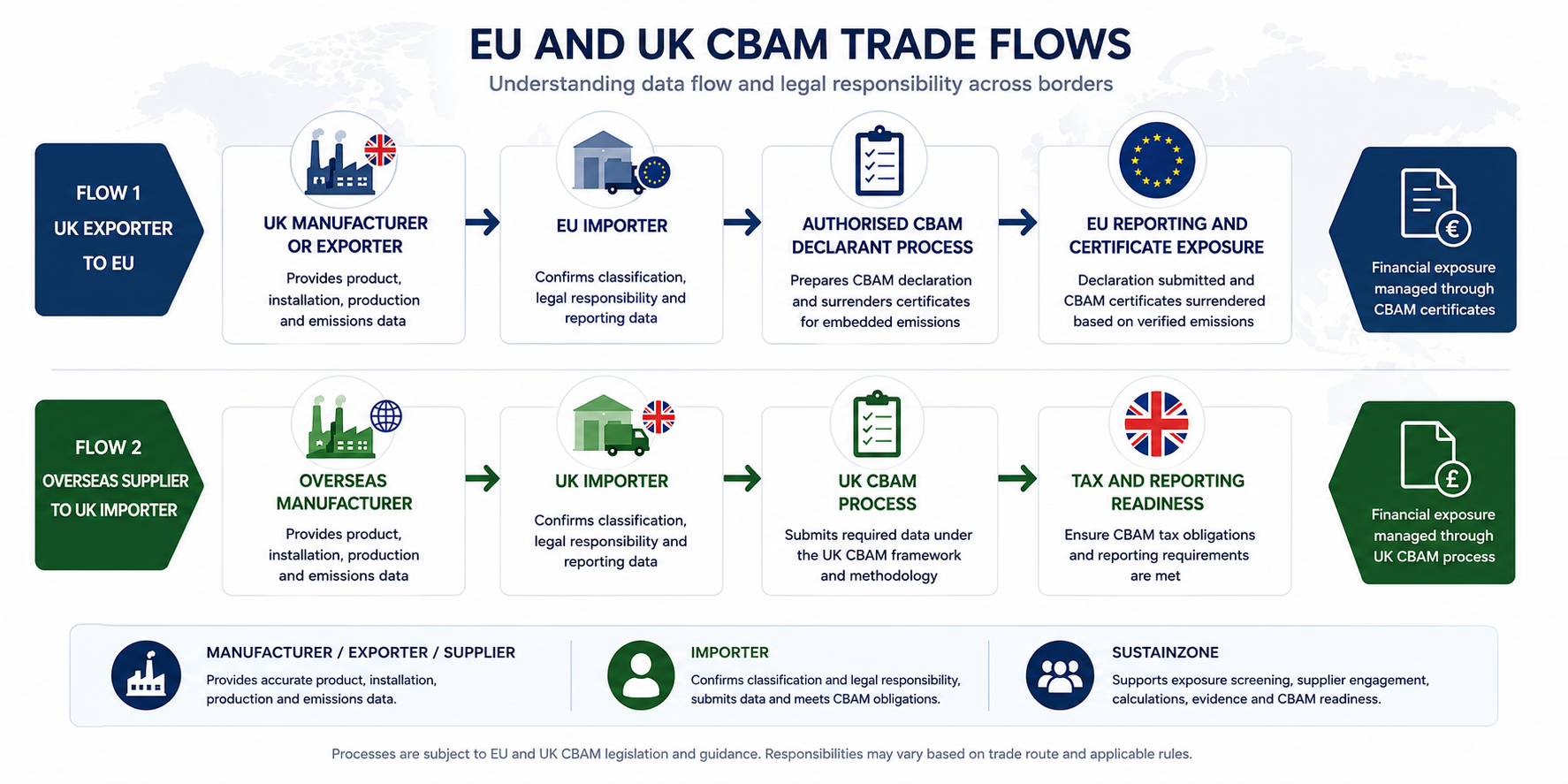
Who Provides the Data and Who Holds the Obligation?

EU CBAM Trade Flow

UK manufacturer or exporter
EU importer
Authorised CBAM declarant process
EU reporting and certificate exposure

UK CBAM Trade Flow

Overseas manufacturer
UK importer
UK CBAM process
Tax and reporting readiness
EU and UK CBAM trade data flow between manufacturers and importers

Manufacturer or exporter

Provides product, installation, production and emissions information.

Importer

Confirms classification, legal responsibility, reporting data and financial exposure.

SustainZone

Supports exposure screening, supplier engagement, calculation, evidence and readiness.

Choose the Right Level of CBAM Support

Our services can be delivered as a focused exposure review, a structured readiness programme or an ongoing managed compliance service.

CBAM Exposure Review

Suitable for: Organisations that do not yet know whether CBAM applies.

  • Product and commodity-code screening
  • Trade-route assessment
  • Legal-entity and importer mapping
  • Initial supplier-data review
  • Preliminary risk register
  • Recommended next actions

Primary outputCBAM Exposure Assessment

Managed CBAM Service

Suitable for: Organisations with recurring import or export activity.

  • Periodic import-data review
  • Supplier follow-up
  • Calculation maintenance
  • Evidence management
  • Exposure monitoring
  • Reporting preparation
  • Regulatory-change tracking
  • Management reporting

Primary outputMaintained CBAM Compliance Process

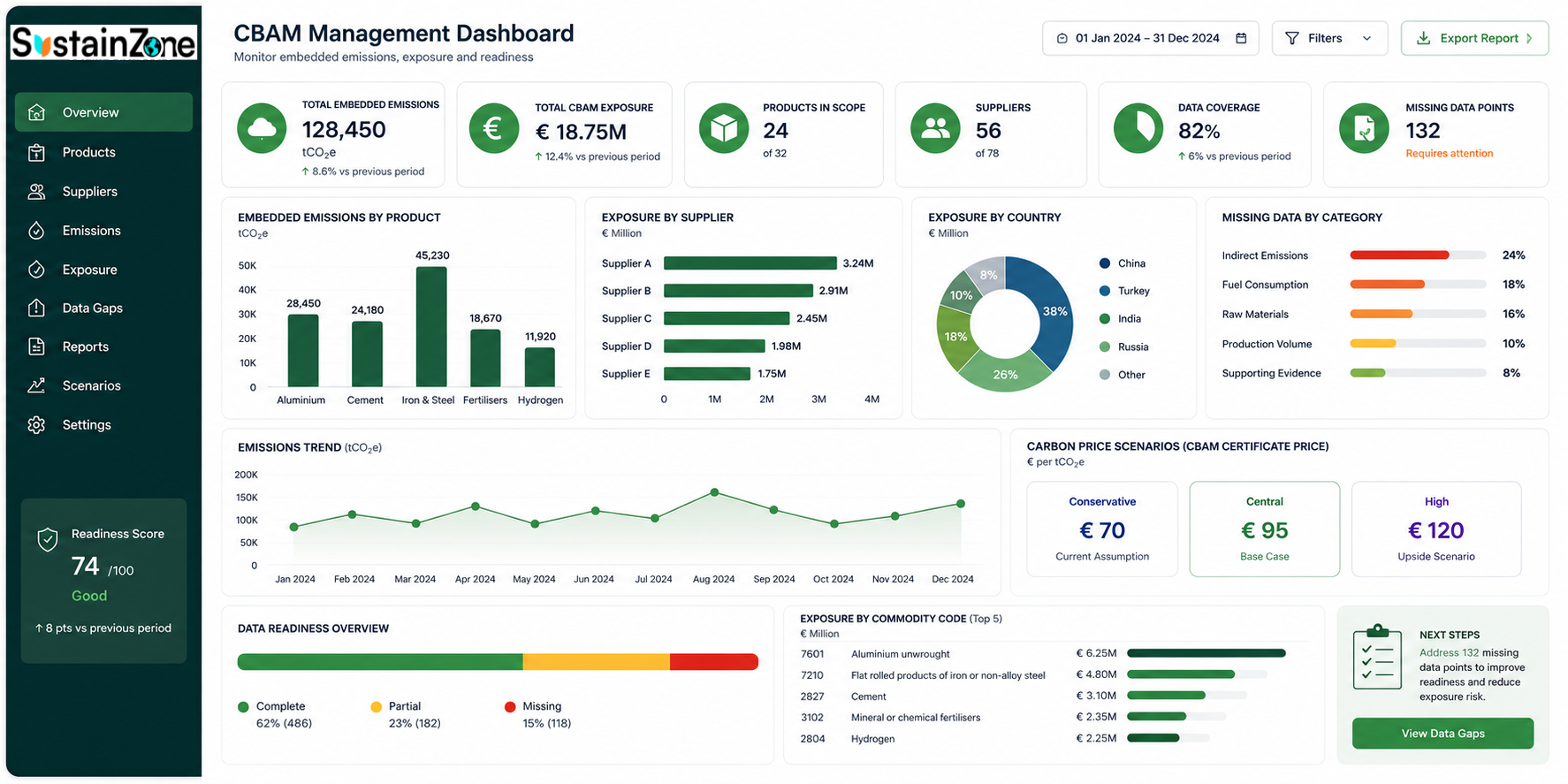
Illustrative CBAM dashboard showing emissions, supplier data gaps and carbon-cost exposure
Illustrative dashboard view. Final outputs depend on client data and the applicable regulatory methodology.

From Supplier Data to Management Insight

A controlled CBAM dataset can support:

  • Product-level embedded-emissions analysis
  • Supplier comparison
  • Missing-data tracking
  • Country and installation exposure
  • Carbon-price scenarios
  • Indicative cost modelling
  • Reporting readiness
  • Management oversight

Our CBAM Services

Exposure and Classification

  • Product and Trade Exposure Screening
  • CBAM Supply-Chain Mapping
  • EU CBAM Declarant Readiness
  • UK CBAM Readiness

Emissions Data and Calculation

  • Supplier Data Collection and Engagement
  • Embedded Emissions Calculation and Methodology
  • Evidence, Controls and Audit Readiness

Commercial and Managed Compliance

  • Carbon-Cost and Commercial Exposure Modelling
  • Managed CBAM Compliance Support

Determine which imported or exported goods may fall within CBAM scope by reviewing product descriptions, commodity codes, customs records, origin, trade routes, quantities, applicable sectors, exemptions and thresholds.

OutputCBAM applicability register identifying in-scope, potentially in-scope and out-of-scope product lines.

Map the importers, exporters, declarants, manufacturers, installations, precursor suppliers, internal data owners and evidence dependencies required for compliance.

OutputResponsibility matrix and CBAM data-flow map.

Create a controlled process for requesting, tracking and validating installation-level production and emissions information from suppliers and overseas manufacturers.

OutputSupplier data pack, evidence tracker and data-gap register.

Calculate or review direct emissions, applicable indirect emissions, production processes, precursor emissions, activity data, allocation rules, default values, carbon prices paid and documented assumptions.

OutputAuditable embedded-emissions calculation workbook and methodology statement.

Support EU importers and supply-chain partners with authorised declarant readiness, annual declaration data, certificate exposure, registry-ready information, verification preparation and internal compliance controls.

OutputDeclarant-readiness pack and reporting dataset.

Prepare importers and overseas suppliers for UK CBAM through product-scope analysis, supplier data readiness, embedded-emissions information, customs and finance alignment, liability modelling and governance planning.

OutputUK CBAM readiness assessment and implementation plan.

Translate embedded-emissions information into financial and commercial insight covering carbon-price scenarios, product-margin sensitivity, supplier differences, procurement alternatives and customer-pricing implications.

OutputCBAM cost model and management dashboard.

Build a defensible evidence trail covering source-data traceability, calculation review, supplier evidence, approval workflows, exceptions, document retention and verification readiness.

OutputCBAM evidence file and compliance-control framework.

Operate the process as an ongoing managed service covering import-data reviews, supplier follow-up, calculation updates, exposure monitoring, reporting preparation and regulatory change tracking.

OutputMaintained CBAM register, calculation model and periodic readiness report.

Our Delivery Methodology

Phase 1

Determine Applicability

Review products, commodity codes, trade routes, quantities and responsible legal entities.

Phase 2

Map Data and Responsibilities

Identify suppliers, installations, customs information, emissions-data owners and internal accountabilities.

Phase 3

Collect and Validate Evidence

Obtain production, activity, emissions and carbon-price information and assess completeness and reliability.

Phase 4

Calculate Embedded Emissions

Apply the relevant methodology, record assumptions and quantify data gaps.

Phase 5

Assess Compliance and Cost Exposure

Evaluate reporting obligations, financial exposure, operational risks and supplier dependencies.

Phase 6

Implement Controls

Establish repeatable workflows, evidence retention, review controls and reporting responsibilities.

Typical CBAM Deliverables

  • CBAM applicability and commodity-code register
  • Importer, exporter and installation map
  • Supplier data-request pack
  • Supplier response tracker
  • Embedded-emissions calculation model
  • Calculation methodology statement
  • Data-quality and evidence-gap assessment
  • EU CBAM declarant-readiness pack
  • UK CBAM implementation roadmap
  • Carbon-cost exposure model
  • Responsibility matrix
  • Audit and verification evidence file
  • Management summary and action plan

How CBAM Works in Practice

UK Steel Manufacturer Exporting Components to an EU Customer

Product Classification

The manufacturer and EU customer confirm whether the exported component falls within the applicable CBAM commodity scope.

Importer Responsibility

The EU customer confirms the importer and authorised declarant arrangements.

Installation Identification

The UK manufacturer identifies the production installation and applicable production route.

Data Collection

Fuel, electricity, production, precursor and carbon-price information is collected.

Embedded Emissions Calculation

The relevant methodology is applied and assumptions, evidence and data gaps are recorded.

Importer Reporting Support

The verified or supported data pack is supplied to the EU importer for CBAM compliance and cost management.

Why Organisations Engage SustainZone

Regulatory Requirements Connected to Operational Data

We connect CBAM requirements to actual customs, procurement, production and supplier information rather than producing a generic policy review.

EU and UK Readiness in One Framework

We distinguish the two regimes while creating one controlled data and governance process capable of supporting both.

Supplier-Focused Implementation

We address the primary operational constraint: obtaining reliable installation-level data from suppliers and manufacturers.

Transparent Calculations and Commercial Insight

Inputs, methodologies, defaults, assumptions and evidence sources are documented, while exposure is translated into procurement, pricing, supplier and margin implications.

CBAM Frequently Asked Questions

No. Applicability depends on the product scope, commodity classification, country of origin, trade route and the relevant regulatory requirements.

The importer or relevant responsible party normally carries the formal obligation. Exporters and manufacturers often hold the production and emissions data required to support compliance.

Usually no. The EU importer or authorised CBAM declarant is generally responsible for the formal declaration, while the exporter or manufacturer provides the required installation and emissions information.

Default values may be permitted in defined circumstances, but actual installation-level information may provide a more accurate and commercially useful result. The applicable methodology must be reviewed.

The organisation should document the data gap, engage the supplier, assess permitted default values and establish a controlled improvement plan.

No. The regimes have different legal, financial, reporting and implementation structures.

The exact role depends on the jurisdiction, legal responsibility, customs arrangements and available authorisation. SustainZone can support data preparation, calculation, evidence management and reporting readiness.

Establish Your CBAM Exposure Before It Affects Trade, Cost or Customer Relationships

A structured CBAM assessment will determine which products are affected, who holds the legal responsibility, what supplier information is missing and what financial exposure may arise.

Other Services

Become part of our
sustainability network

Get exclusive access to insights, trends, and expert opinions by subscribing to our community

500 characters left

Please enter a valid email address.

Sustain Zone Community Image

You've successfully subscribed

Your email is added to the list securely to get you the latest updates.